
Urban Myth: The Ripper Murders weren’t investigated properly.
Unfortunately, this myth is true.
On Thursday 20 December 1888, a constable found prostitute Rose Mylett strangled in Clarke’s Yard, off Poplar High Street. Four doctors who examined Mylett’s body thought she had been murdered, but Robert Anderson, Assistant Police Commissioner and head of the Criminal Investigation Department, thought she had accidentally strangled herself on the collar of her dress while in a drunken stupor. At Anderson’s request Dr Bond, the Police Surgeon, examined Mylett’s body, and – perhaps not unexpectedly – agreed with Anderson. Police Commissioner Monro also suspected it was a suicide or a natural death as there were no signs of a struggle. Nevertheless, the coroner’s jury returned a verdict of ‘wilful murder against some person or persons unknown’.
Despite the coroner’s verdict, Anderson refused to conduct an investigation as he’d already examined the body and deemed it an accidental death. Further investigation, he thought, was both unnecessary and a waste of time. At autopsy, Mylett’s stomach contents were examined and found to be alcohol free, remarkable for someone who purportedly died in a drunken stupor.
Police Commissioner Munro did not insist on a proper police investigation into Mylett’s death or reprimand Anderson for what was a blatant dereliction of duty.
She was only one of a number of women to be murdered in and around Whitechapel in London between 1888 and 1891. Most authorities consider the Whitechapel murders claimed 11 victims between 3 April 1888 and 13 February 1891. Five of these killings, committed over 4 nights between August and November 1888, are infamous because of their association with Jack the Ripper. Even though the killings occurred more than 120 years ago, neither the police nor the many investigators who have taken an interest in the case have managed to discern a pattern to the killings. Many theories have been developed to explain Jack’s murderous rampage and why he mutilated his victims so horribly; and with each new theory, a new suspect has emerged. Even the FBI has seen fit to develop a profile on Jack.
But, in their rush to publish their ideas and theories, have the investigator’s ignored crucial evidence which invalidates almost all of their conclusions? Most diaries contain two numbers associated with each date, the day of the year and the number of days until the end of the year. This information is also displayed on many loose leaf desk calendars. When we examine the 11 Whitechapel murders using this simple technique, we get the table shown below.
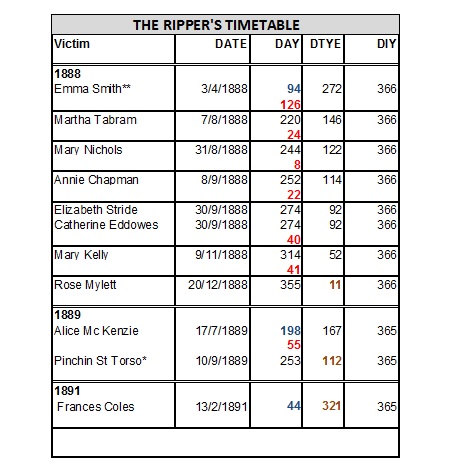
*date body found **date of attack
The figures shown in red represent the days between attacks; the figures in blue show the day of the year on which the first killing occurred; and finally, the brown figures record the number of days from the final killing in a year to the end of that year. This gives us three series of numbers:
126, 24, 8, 22, 40, 41, 55 (total 316);
94, 198, 44 (total 336); and
11, 112, 321 (total 444).
Henceforth, these series will be referred to as the red, blue and brown series.
The Brown Series
The sum of the first two number in the brown series (11 and 112) total 123, which is the final number in the series, 321, with its digits reversed.
The Red Series
The first six elements in the red series can be combined into two, related lots of three:
126, 24, 8, 22, 40, 41, 55
The first number, 126, is twice the sum of 22 and 41.
126, 24, 8, 22, 40, 41, 55
The second number, 24, is half the sum of 40 and 8.
Thus, the numbers form interrelated 2:1 patterns.
The final number in the red series, 55, can be linked to two numbers in the blue series.
The second element in the blue series, 198, is twice the sum of 55 and 44, the last element in the blue series.
126, 24, 8, 22, 40, 41, 55
94, 198, 44
Once again, a 2:1 ratio and pattern is evident.
The Blue Series
All three series are required to show the relationship between all of the elements in the blue series.
126, 24, 8, 22, 40, 41, 55
94, 198, 44
11, 112, 321
When we subtract the last number in the blue series, 44, from the first number in the series, 94, the answer is 50.
94, 198, 44
The second step is to determine the number of days from the first murder to the fist of the Ripper murders, i.e. 126 + 24 or 150.
126, 24, 8, 22, 40, 41, 55
The final step is to determine the number of days from the final Ripper murder to the first murder in the second year, i. e. 41 + 11 + 198 or 250.
126, 24, 8, 22, 40, 41, 55
94, 198, 44
11, 112, 321
Thus, linking the elements in the blue series via the Ripper murders gives us the relationship 50:150:250. All the numbers in the blue series are used; the first, second and second last numbers in the red series are used; and the first number in the brown series is used. This, of course, generates a number of 2:1 relationships.
126, 24, 8, 22, 40, 41, 55
94, 198, 44
11, 112, 321
Apart from introducing the idea of the 2:1 ratios or relationships; showing that all 11 murders are linked; and establishing that the murders weren’t random acts of violence, what do the calculations show?
The short answer is: very little. They are mere embroidery or showing-off. I’ve chosen to lead with these patterns because it is this aspect of the Whitechapel murders which had the greatest impact on the Black Dahlia Avenger and the Zodiac.
The mere fact that all eleven killings are linked and the killer is both sane and and highly intelligent is sufficient to eliminate all of the primary suspects in the case. Furthermore, the victim of the first attack described three assailants, one of whom was a boy of about 19 years of age. Rather than a single individual we have a gang . . . and a conspiracy.
The religious, political and Masonic messages hidden in the numbers will be examined in future posts.